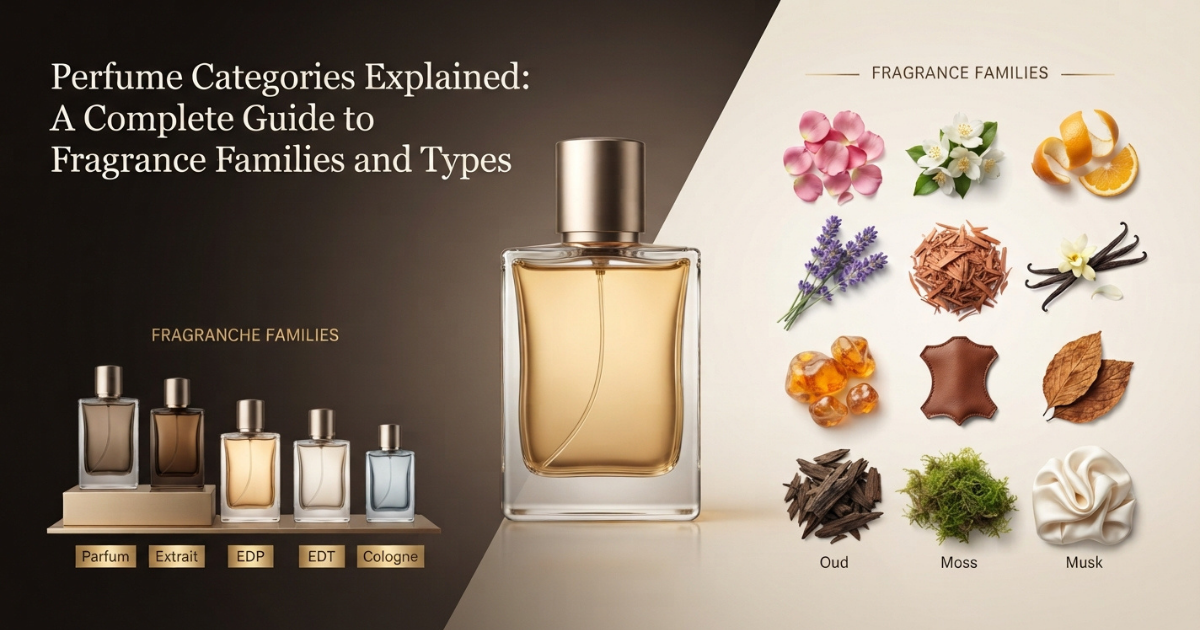
Perfume categories describe two separate things: a fragrance’s concentration and its scent family. Parfum, Extrait, Eau de Parfum, Eau de Toilette and Eau de Cologne are concentration labels. Floral, woody, amber, fresh and other fragrance families describe how a perfume smells.
One bottle can belong to both classifications. A perfume might be a floral Eau de Parfum, a woody Extrait or a citrus Eau de Toilette. Knowing the concentration does not tell you its scent, and knowing its family does not establish its strength or lasting power.
This guide explains the different types of perfumes, compares popular perfume scent categories and shows how to choose a fragrance family. Examples from the La Saintos perfume collection help connect those descriptions with actual fragrances.
Perfume Categories by Concentration and Fragrance Family
The easiest way to understand perfume categories is to ask two questions about the bottle.
| Classification | Question it answers | Examples |
|---|---|---|
| Concentration | What concentration format is this product sold in? | Parfum, Extrait, EDP, EDT and Eau de Cologne |
| Fragrance family or scent style | What does the fragrance smell like? | Floral, woody, amber, citrus, gourmand and musky |
These classifications work together. A higher concentration can change a fragrance’s feel or development, while its dominant notes determine its scent direction. Neither classification replaces the need to test the complete perfume.
Designer, niche, men’s, women’s and unisex are further descriptions used in fragrance retail. They describe positioning or the intended market, rather than creating additional concentration levels.
Part 1: Perfume Categories by Concentration
Perfume categories based on concentration describe the proportion of fragrance compound in the finished product. That compound is a mixture of aromatic materials, not necessarily a blend of natural essential oils alone.
The International Fragrance Association’s concentration guidance gives typical ranges for alcohol-based fragrances and explicitly notes that concentration labels have no universally fixed definitions.
| Concentration label | Typical range or usage | Important distinction |
|---|---|---|
| Parfum | A concentrated format; often used interchangeably with Extrait | It has no universally separate percentage band |
| Extrait de Parfum | Typically 15–40% for perfume extract | An extract is not necessarily 100% fragrance compound |
| Eau de Parfum or EDP | Typically 10–20% | Its formula may differ from the EDT in the same range |
| Eau de Toilette or EDT | Typically 5–15% | The label does not automatically mean weak performance |
| Eau de Cologne or EDC | Typically 3–8% | The formal concentration term differs from casual use of “cologne” |
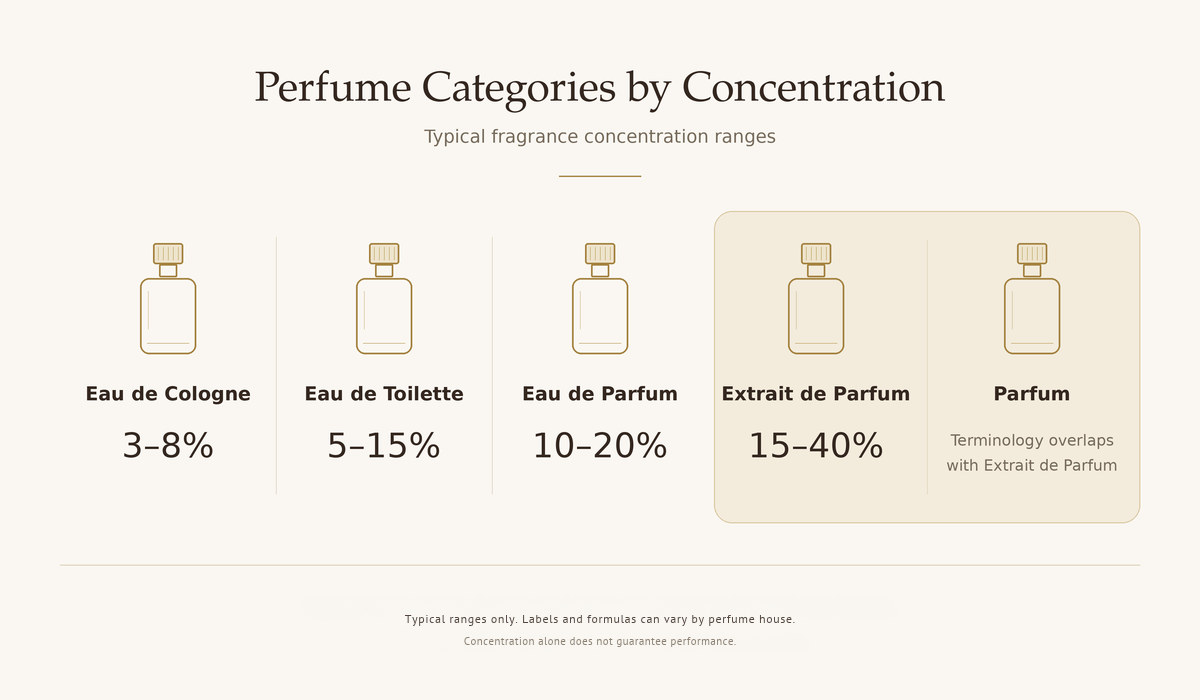
The numeric ranges above follow IFRA’s guidance. Parfum and Extrait overlap in perfumery terminology, so they should not be presented as universally separate steps on a fixed strength ladder.
Parfum and Extrait de Parfum
Parfum and Extrait usually identify concentrated perfume formats. Some houses use the terms interchangeably, while others attach them to distinct products. The manufacturer’s description therefore matters more than an assumed hierarchy.
A concentrated perfume may feel rich or remain close to the skin. It does not automatically create the largest scent cloud. Likewise, two Extraits can behave differently because their ingredients and intended effects differ.
For a product-specific example, Essential Parfums states that Bois Impérial Extrait has a 32% concentration. That disclosed percentage applies to this perfume; it should not be assigned to every bottle labelled Extrait.
Eau de Parfum
Eau de Parfum is a common format across designer and specialist perfume houses. It can carry a fresh, floral, woody, amber or gourmand composition.
When comparing versions, check the notes as well as the concentration label. An EDP may interpret a fragrance differently from its EDT rather than simply containing more of an identical mixture. Buy the version whose development you prefer.
Eau de Toilette
Eau de Toilette usually contains a lower proportion of fragrance compound than EDP, although typical ranges overlap. Many EDTs emphasise an airy or sparkling impression, but the format is not restricted to fresh scents.
An EDT can still be noticeable and persistent. Its performance depends on the actual formula, application and conditions, so a concentration chart cannot reliably promise a specific number of hours.
Eau de Cologne
Eau de Cologne is typically a lighter concentration format. Traditional cologne compositions often feature citrus and aromatic notes, but concentration and scent character remain separate concepts.
In everyday conversation, “cologne” is also used loosely for men’s fragrance. A product described casually as a cologne might actually be an EDP. Read the full label before comparing bottles.
Concentration Is Different from Performance
Three terms make performance descriptions easier to interpret:
- Longevity means how long the fragrance remains detectable.
- Projection describes how far it radiates from the wearer.
- Sillage describes the scented trail left as the wearer moves.
A perfume can last well while projecting softly. Treat claims about “strength” as incomplete unless they explain which of these characteristics is being described.
Part 2: Fragrance Families and Perfume Scent Categories
Fragrance families classify perfumes by their dominant olfactory character. However, perfume categories do not follow one universal taxonomy.
Michael Edwards’ Fragrance Wheel groups related scent directions, while The Perfume Society’s family guide uses a different arrangement. Citrus and aromatic styles often sit within fresh groupings. Leather, tobacco, oud and musk may describe dominant accords or scent styles rather than standalone families in every system.
The following perfume categories cover 12 common scent descriptions used in shopping. They are useful scent directions, not a claim that perfumery has exactly 12 mutually exclusive families.
| Scent category | Main impression | Common notes or accords |
|---|---|---|
| Floral | Petal-like, powdery or richly flowery | Rose, jasmine, iris, orange blossom and tuberose |
| Woody | Dry, creamy, earthy or smoky | Cedar, sandalwood, vetiver and patchouli |
| Amber | Warm, resinous, balsamic or sweet | Labdanum, benzoin, vanilla and spices |
| Fresh | Airy, green, watery or bright | Green leaves, marine accords, herbs and citrus |
| Citrus | Zesty, juicy or bitter | Bergamot, lemon, grapefruit and mandarin |
| Aromatic | Herbal, green or camphoraceous | Lavender, rosemary, sage and thyme |
| Gourmand | Reminiscent of edible treats | Vanilla, caramel, chocolate, coffee and honey |
| Leather | Suede-like, smoky or dry | Leather accords, smoky woods and supporting spices |
| Tobacco | Hay-like, sweet, dry or earthy | Tobacco leaf impressions, honey, spices and woods |
| Oud | Deeply woody, resinous or animalic | Agarwood notes, often paired with rose, amber or leather |
| Chypre | Bright opening over a dry, mossy foundation | Bergamot, mossy accords, patchouli and labdanum |
| Musky | Clean, soft, powdery or skin-like | Musk materials and musky accords |
Floral Perfumes
Floral fragrances place flowers at the centre of the composition. A single-flower style may emphasise rose or jasmine, while a floral bouquet combines several impressions.
The differences within this category are substantial. Iris can feel powdery, orange blossom may seem bright, and tuberose can create a dense floral effect. Ask which flowers dominate rather than assuming all florals smell alike.
Floral notes also appear in men’s and unisex perfumes. Gender labels do not define a fragrance family.
Woody Perfumes
Woody fragrances emphasise dry, creamy, earthy or smoky effects. Cedar can suggest pencil shavings or dry timber, while sandalwood often contributes a smoother, creamier impression. Vetiver and patchouli can add earthy depth.
This category includes both fresh woods and darker compositions. If you like woody perfume, decide whether you prefer crispness, creaminess or smoke; that distinction will narrow your shortlist more effectively than the word “woody” alone.
Amber Perfumes
Amber fragrances often combine resins, sweetness, spices and warm balsamic effects. They may feel dry and incense-like or soft and vanilla-rich.
Amber is an olfactory accord rather than a promise that fossilized amber is an ingredient. It should also not be confused with ambergris, a different perfumery term.
You may still encounter “oriental” in older descriptions. Many contemporary guides use amber or ambery for this area of perfumery. Serge Lutens Ambre Sultan is an example to explore for resinous amber with vanilla and patchouli.
Fresh Perfumes
Fresh is a broad scent description that can include citrus, green, aquatic and aromatic styles. A fresh perfume might suggest crushed leaves, watery air, herbs or citrus peel.
Freshness does not establish concentration. A fragrance can smell bright while being sold as an EDP or Extrait. Look at both labels separately and consider the base notes, because a fresh opening may settle into a much warmer composition.
Citrus Perfumes
Citrus fragrances emphasise lemon, bergamot, mandarin, grapefruit and related impressions. Some feel juicy and sweet; others highlight bitterness or the sharpness of peel.
Citrus often sits within the wider fresh family, but it deserves separate attention when comparing perfume scent categories. A watery marine perfume and a bitter bergamot fragrance can both feel fresh while smelling quite different.
Judge the dry-down too. A citrus opening may lead into woods, musk, florals or moss.
Aromatic Perfumes
Aromatic fragrances emphasise herbs such as lavender, rosemary, sage or thyme. Their character may be green, dry, cooling or reminiscent of an herb garden.
They frequently overlap with fresh and woody styles. Fougère is a related classic structure often associated with lavender, a coumarin-like sweetness and a mossy foundation; it is not simply another word for every aromatic fragrance.
Explore this direction if you enjoy herbal freshness more than sugary fruit or dense floral notes.
Gourmand Perfumes
Gourmand fragrances evoke edible smells such as vanilla, caramel, chocolate, coffee or honey. They can range from a subtle sweet accent to a composition strongly reminiscent of dessert.
Sweetness alone does not describe the whole perfume. Woods, spices or tobacco can make a gourmand feel drier and more textured. Nor does a food-like note mean the perfume contains the edible ingredient itself.
Xerjoff Naxos combines honey and vanilla facets with lavender and tobacco, illustrating how gourmand effects can overlap with other scent styles.
Leather Perfumes
Leather perfumes recreate impressions ranging from soft suede to smoky, dry leather. The effect is an accord assembled from aromatic materials rather than a literal extract of a leather jacket.
The Perfume Society’s leather guide describes how different materials can produce this impression. Leather can be paired with flowers, woods, tobacco or sweetness, so sample the exact composition instead of assuming every leather fragrance will feel heavy or harsh.
Tobacco Perfumes
Tobacco in perfume can suggest dried leaves, hay, soft sweetness, spices or an earthy warmth. It does not automatically mean the smell of cigarette smoke.
A tobacco composition may be honeyed and smooth, dry and woody, or darker and smoky. Those distinctions matter when choosing between products. The Perfume Society’s tobacco profile explains the material’s sweet, earthy and hay-like facets.
Consider the accompanying notes: vanilla and honey create a different balance from leather and dry woods.
Oud Perfumes
Oud refers to agarwood and the scent directions associated with it. Depending on the material and composition, an oud fragrance may feel woody, resinous, smoky, earthy or animalic.
Finished perfumes often soften or reshape oud with rose, amber, fruit, vanilla or leather. The presence of “oud” in a product name does not establish the quantity or use of natural agarwood oil; oud effects can also be reconstructed through accords.
If oud is unfamiliar, compare contrasting examples before deciding whether you enjoy the style.
Chypre Perfumes
Chypre fragrances traditionally contrast a bright opening with a dry, mossy foundation. Bergamot, oakmoss, patchouli and labdanum are classic reference points, although modern interpretations and materials vary.
Chypre can be floral, fruity, green or leathery. The underlying contrast matters more than any one top note. Nishane Hacivat demonstrates this idea through a pineapple-and-citrus opening over mossy woods; Nishane describes it as an eau chypre.
Musky Perfumes
Musky fragrances can feel clean, soft, powdery, warm or close to the skin. Some suggest freshly washed fabric, while others have a deeper, more animalic character.
Musk is not one identical smell. Modern perfumery uses a range of musk materials, and the surrounding flowers, woods or amber change the overall effect.
A perfume containing musk is not automatically a musk-dominant fragrance. Look for descriptions of the finished composition rather than relying on one ingredient mentioned in its base.
Perfume Types Explained Through Product Examples
These examples show how perfume categories describe the same product through concentration and scent direction. They also demonstrate why fragrance families can overlap.
| Perfume listed at La Saintos | Concentration and listed size | Scent directions to explore |
|---|---|---|
| Yves Saint Laurent MYSLF | EDP, 100 ml | Floral and woody, with bergamot and orange blossom |
| Dior Sauvage Parfum | Parfum, 100 ml | Citrus and woody, with mandarin, tonka bean and sandalwood |
| Serge Lutens Ambre Sultan | EDP, 100 ml | Resinous amber with vanilla and patchouli |
| Xerjoff Naxos | EDP, 100 ml | Aromatic, tobacco and gourmand facets |
| Nishane Hacivat | Extrait, 100 ml | Fruity citrus, chypre and woody facets |
| Essential Parfums Bois Impérial Extrait | Extrait, 30 ml | Woody, ambery, spicy and leathery facets |
These descriptions draw on the houses’ product information. They identify useful scent characteristics rather than assigning every perfume to an exclusive category. Check the live listing for bottle variations and current availability.
Dior and Yves Saint Laurent are designer fragrance names, while houses such as Nishane and Essential Parfums specialize in perfumery. Neither positioning guarantees a better match. Use the La Saintos brands directory to explore individual houses, then compare their actual products.
How to Choose a Fragrance Family
Learning how to choose a fragrance family starts with familiar smells. Think about fragrances you already enjoy and identify whether the recurring attraction is citrus, flowers, herbs, woods, sweetness or something darker.
Use perfume categories to shortlist two or three examples within your preferred style. A useful first comparison might be fresh citrus against aromatic woods, or a dry amber against a sweeter gourmand. This helps you identify a direction without testing an overwhelming number of bottles.
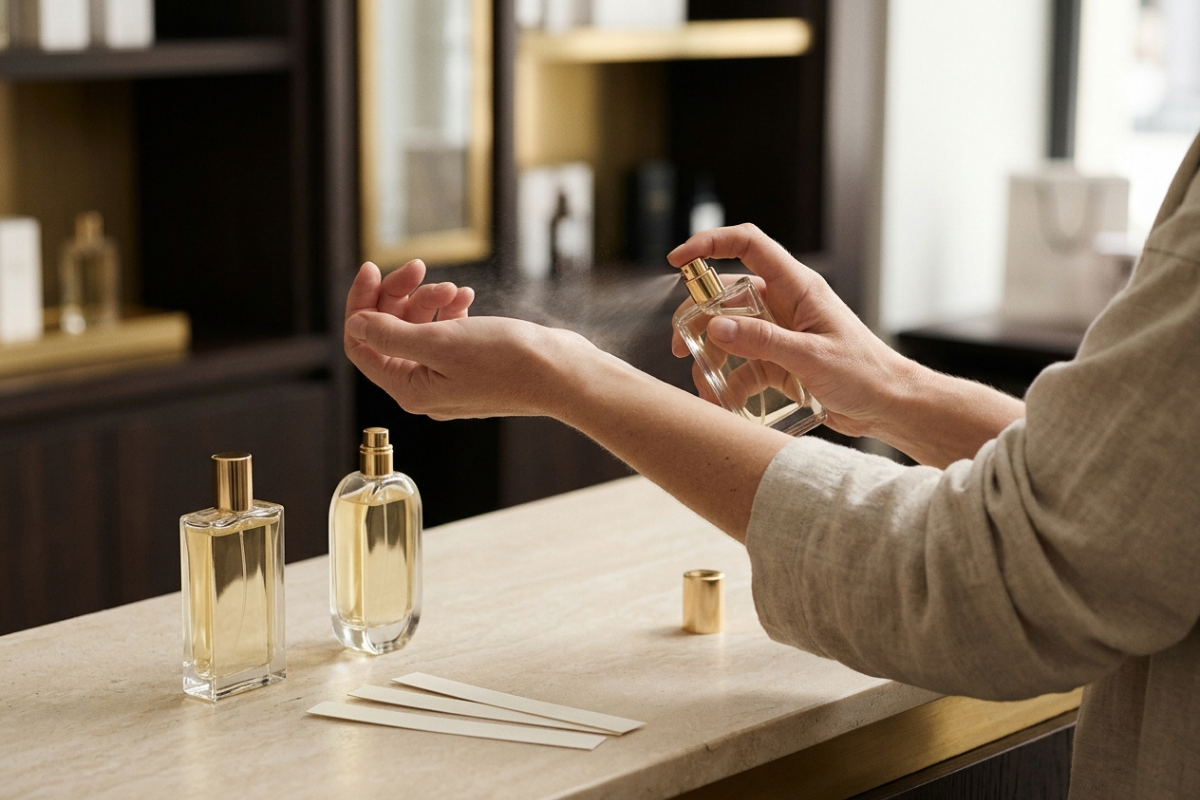
Try shortlisted perfumes on blotters first, then test your favourites on skin according to their directions. Pay attention to the opening, the heart after it settles and the later dry-down. Those stages overlap, and the first spray may not represent what you will wear for most of the day.
Consider your surroundings as well. For a shared office, moderate projection may matter more than maximum longevity. If you prefer richer scents for evenings, explore amber, tobacco, leather or gourmand compositions. These are starting points based on preference, not restrictions on when a family can be worn.
In Karachi’s warm conditions, test a perfume during a normal day where possible. Skin and air temperature affect evaporation, so a brief air-conditioned shop test may give an incomplete impression.
Choose the concentration after identifying a scent you enjoy. If several versions exist, compare them individually. An EDP, EDT and Parfum sharing a name can have different balances of notes, making each a separate buying decision.
Explore Perfume Categories at La Saintos
Compare concentration and fragrance family as separate parts of the same decision. First identify the scent directions you enjoy, then assess the exact formula, concentration and performance on your skin.
Browse the La Saintos perfume collection to explore designer and specialist houses across several perfume categories. Use the product details to compare precise versions and build a shortlist around your preferences.
Frequently Asked Questions
What Are the Two Main Ways to Classify Perfume Categories?
Concentration labels describe the fragrance format, including Parfum, Extrait, EDP, EDT and Eau de Cologne. Fragrance families describe scent character, such as floral, woody, amber or fresh. One perfume belongs to both classifications.
Is Extrait Always Stronger Than Parfum?
No universal rule separates them. Parfum and Extrait often name the same concentrated format, although brands may use the labels for different products. Check the manufacturer’s information rather than assuming a fixed ranking.
Is EDP a Fragrance Family?
No. EDP means Eau de Parfum, a concentration label. A perfume can be a floral EDP, woody EDP or amber EDP. The concentration does not identify its scent family.
Are Citrus and Fresh the Same Category?
Citrus commonly sits within the broader fresh grouping, but fresh also includes green, watery and aromatic styles. A marine fragrance and a bergamot-led perfume may both feel fresh while smelling different.
Are Oud, Tobacco and Leather Always Separate Fragrance Families?
Classification systems differ. Oud, tobacco and leather often describe dominant notes, accords or scent styles within broader families. They are useful shopping terms, but they do not occupy an identical place in every fragrance taxonomy.
Which Types of Perfumes Last the Longest?
No concentration or scent family guarantees the longest wear. Ingredients, formulation, application, skin and surroundings affect performance. Compare individual perfumes and distinguish longevity from projection.
Can One Perfume Belong to Several Fragrance Families?
Yes. A fragrance may combine woody and floral characteristics or pair tobacco with gourmand sweetness. Family labels highlight dominant traits rather than requiring every perfume to fit one exclusive box.
How Do I Choose a Fragrance Family for the First Time?
Start with smells you already enjoy, shortlist a few contrasting examples and test them on skin. Compare the dry-down as well as the opening, then select the concentration and bottle size that suit your use.


 No products in the cart.